

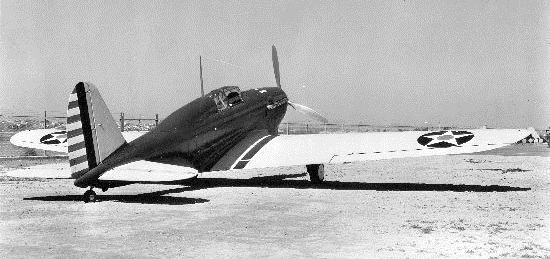
P-30 / PB-2 Pursuit Aircraft
Consolidated’s Leap Toward the Modern Fighter Era
The Consolidated P-30 (Army designation) / PB-2 (Navy designation) was one of the most advanced pursuit aircraft of its time and marked the company’s most significant contribution to early American fighter development. Designed during the transition from biplanes to high-speed monoplanes, the P-30 pushed boundaries in power, aerodynamics, and cockpit technology—setting precedents that shaped the evolution of U.S. fighters throughout the 1930s.
Although built in limited numbers, the aircraft became known for its bold innovations, unique performance characteristics, and its role as one of the first U.S. military planes to incorporate features that later became standard.
Design Innovations Ahead of Their Time
The P-30 / PB-2 introduced several cutting-edge features rarely seen in pursuit aircraft of the early 1930s:
Turbo-Supercharged Engine
Equipped with a turbo-supercharger, the aircraft could sustain power at high altitudes—giving it a performance edge in climb and interception missions.
Enclosed Cockpit
At a time when most fighters still used open cockpits, the P-30 protected the pilot with an early canopy design, improving comfort and aerodynamic efficiency.
All-Metal Construction
The sturdy metal airframe offered strength, rigidity, and improved durability compared to earlier fabric-and-wood fighters.
Retractable Landing Gear
Retractable gear dramatically reduced drag, increasing speed and giving the aircraft a sleeker profile than its contemporaries.
These features reflected a new era in pursuit aircraft—one in which speed, altitude, and aerodynamic refinement were becoming central to air combat strategy.
Performance & Handling
Pilots noted that the P-30 / PB-2 delivered:
-
excellent altitude performance
-
strong structural integrity
-
responsive controls at cruising speed
-
improved visibility from its enclosed cockpit
However, it also presented challenges:
-
early turbo-superchargers were complex and maintenance-intensive
-
handling at low speeds required greater skill
-
landing approaches demanded precision due to the higher wing loading
The aircraft became a valuable training and evaluation platform for pilots transitioning into the next generation of fast, powerful fighters.
Limited Production, Significant Impact
Only a modest number of P-30 / PB-2 aircraft were produced, but their influence extended far beyond their quantity. The aircraft:
-
informed Air Corps decisions about high-altitude fighter requirements
-
contributed to the shift toward fully enclosed cockpits
-
provided experience with retractable landing gear
-
helped refine the use of turbo-superchargers
-
paved the way for more advanced pursuit aircraft later in the decade
For Consolidated, it was proof that the company could build high-performance fighters—though its future would lie in bombers and flying boats rather than pursuit planes.
Role in Tactical Development
During its service, the P-30 helped shape aerial tactics in several key ways:
-
demonstrating how altitude advantage could determine combat outcomes
-
training pilots to manage higher landing speeds and more sophisticated systems
-
evaluating early canopy and cockpit ergonomics
-
testing metal airframe stress limits under demanding maneuvers
These lessons contributed directly to the development of U.S. fighter doctrine prior to World War II.
Legacy
While overshadowed by later legends such as the P-40, P-38, and P-51, the P-30 / PB-2 remains a milestone aircraft. It embodied the transition from the open-cockpit biplane era to the fast, modern, enclosed-cockpit fighters that would dominate World War II.
For Consolidated, it was a brief but meaningful venture into pursuit design—demonstrating engineering ambition and contributing to the company’s growing technical expertise.
Explore More Aircraft
Return to the Pursuit Aircraft category
Return to the Hangar