

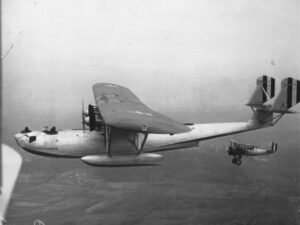
XPY-1 Admiral
The XPY-1 Admiral represents one of Consolidated Aircraft’s earliest steps toward true long-range maritime patrol aviation. Developed at a time when naval aviation was still defining its purpose beyond coastal defense, the Admiral helped establish the design logic that would later culminate in far more famous flying boats.
In the late 1920s, the U.S. Navy began to recognize that future conflicts would demand aircraft capable of operating far from land, maintaining surveillance over open ocean for extended periods. The XPY-1 emerged from this requirement—not as a perfected solution, but as an essential learning aircraft in a rapidly evolving field.
An Early Long-Range Patrol Concept
The Admiral was designed as a patrol bomber flying boat, intended to combine endurance, seaworthiness, and operational range. While later aircraft would surpass it in capability, the XPY-1 helped clarify what naval patrol aviation needed to become.
Its development reflected a shift in thinking:
-
reconnaissance had to extend hundreds, not tens, of miles offshore
-
aircraft would need to operate independently for long durations
-
water-based operations offered flexibility unavailable to landplanes
These ideas were still being tested, refined, and debated when the Admiral took shape.
Design Significance
Though produced in limited numbers, the XPY-1 contributed to Consolidated’s growing expertise in flying-boat construction. Hull form, wing placement, engine configuration, and crew accommodations were all part of an ongoing process to balance range, stability, and seaworthiness.
The lessons learned from the Admiral directly informed subsequent designs—most notably the P2Y Ranger, which would bring many of these concepts to operational maturity.
Place in the Evolution of Flying Boats
The XPY-1 Admiral is best understood not as an endpoint, but as a foundation. It occupies an important position in the lineage of Consolidated flying boats, marking the transition from experimental patrol concepts to aircraft that could reliably serve fleet-wide reconnaissance needs.
In this sense, the Admiral’s legacy lies less in its individual service record and more in its role as a stepping stone—one that helped shape the aircraft that followed.
Legacy
While later flying boats would become far more famous, the XPY-1 Admiral remains a meaningful chapter in Consolidated’s history. It reflects the early confidence of a company learning how to project air power across oceans, and the willingness to explore new solutions at a time when the future of naval aviation was still being written.
The Admiral set the course. Others would sail much farther—but only because this first step was taken.