

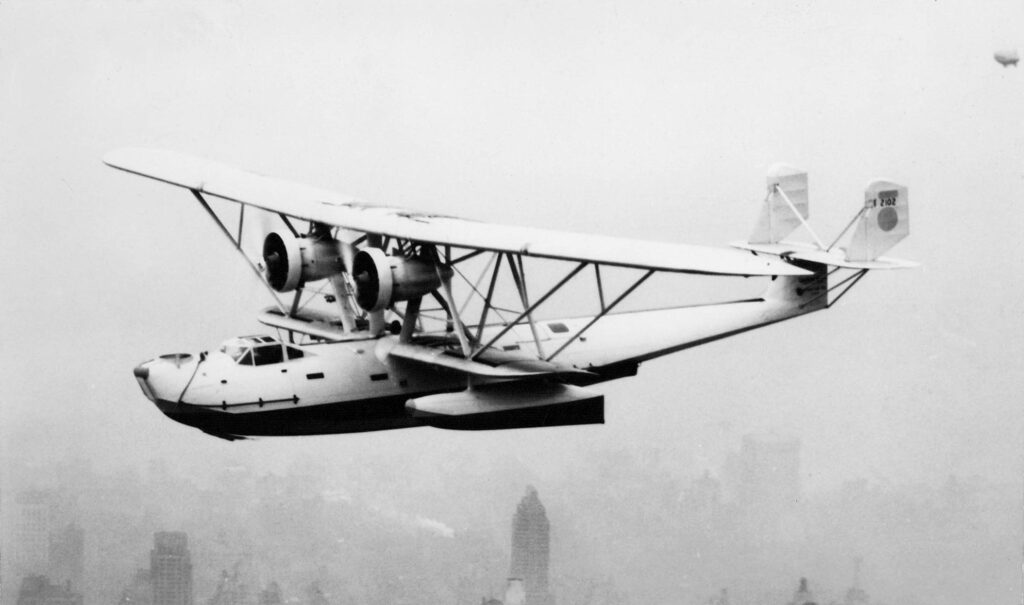
P2Y Ranger / Rangemaster
The P2Y Ranger marked a decisive step forward in Consolidated’s flying-boat development. Where earlier patrol aircraft explored possibilities, the P2Y proved that long-range maritime reconnaissance could be practical, reliable, and operationally decisive.
Introduced in the early 1930s, the Ranger arrived at a moment when naval planners were no longer asking if patrol aircraft were necessary, but how far they could reach. The answer, demonstrated convincingly by the P2Y, was: far enough to change the character of naval surveillance.
Proving Long-Range Patrol
The P2Y was designed to operate for extended periods over open ocean, maintaining patrol coverage well beyond the reach of coastal aircraft. In service, it validated the Navy’s emerging doctrine of wide-area maritime reconnaissance.
In 1933, a formation of P2Y aircraft flew more than 2,000 miles from the U.S. East Coast to the Canal Zone—an achievement that underscored both the aircraft’s endurance and the growing confidence of naval aviation in sustained over-water operations. Flights of this length were no longer exceptional demonstrations; they were becoming routine expectations.
Design Evolution and Refinement
As experience accumulated, the P2Y underwent a series of refinements aimed at improving performance, reliability, and range. Engineers focused on:
-
improving engine installation and airflow
-
refining wing and nacelle integration
-
increasing cruise efficiency for long patrols
-
enhancing crew endurance on extended missions
These improvements resulted in successive variants that steadily raised the aircraft’s operational value, while also providing critical design lessons for future flying boats.
Variants Overview
P2Y-1
The initial production version, which quickly demonstrated the feasibility of long-range patrol flying boats in fleet service.
P2Y-2
A designation applied to aircraft modified with improved engine placement and aerodynamic refinements, often accomplished through conversion kits that allowed earlier aircraft to be upgraded in the field.
P2Y-3
The most refined production version, incorporating accumulated improvements and delivered in greater numbers as the Navy expanded its patrol capabilities.
Each variant represented incremental progress rather than radical redesign—a hallmark of Consolidated’s approach to aircraft evolution.
Bridge to the Catalina
The true importance of the P2Y lies in what followed. Its operational success confirmed the Navy’s commitment to long-range flying boats and provided the experience necessary to pursue an even more capable design.
That next step would be the XP3Y / P3Y prototype, which evolved directly into the PBY Catalina.
In this way, the Ranger stands as the aircraft that transformed long-range patrol from an ambitious idea into an established operational reality.
Legacy
The P2Y Ranger may lack the enduring fame of the Catalina, but its impact was profound. It proved that oceans could be patrolled systematically from the air and that flying boats could serve as reliable, front-line naval assets.
Without the Ranger, the Catalina would not have been possible. The P2Y laid the groundwork—quietly, methodically, and effectively—for everything that came after.