

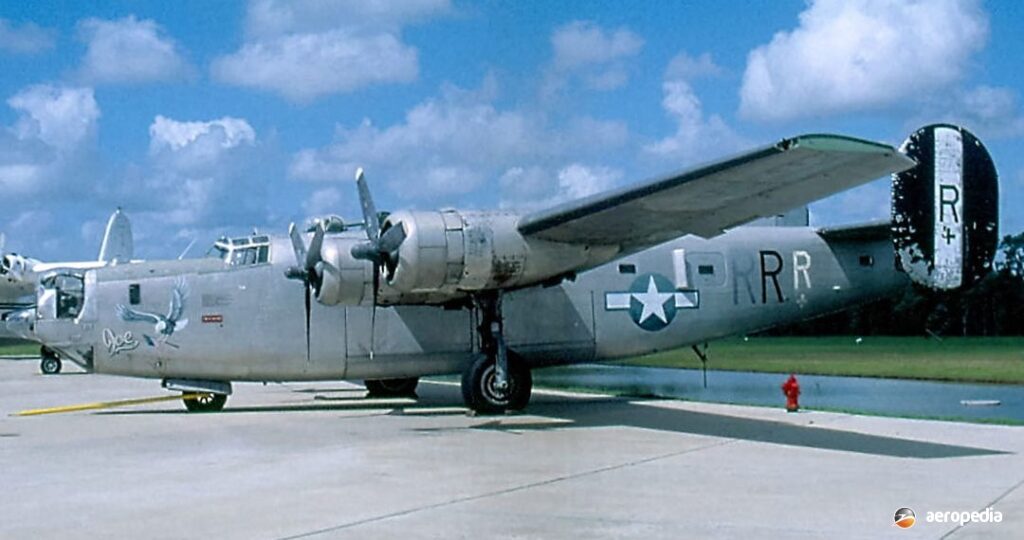
B-24 Liberator
The Bomber That Changed the Scale of War
The Consolidated B-24 Liberator was more than a bomber. It was an industrial achievement, a strategic instrument, and a defining symbol of Allied air power during World War II.
Designed for long range, high payload, and mass production, the B-24 became one of the most important aircraft of the war. It served in every major theater, flew a wide variety of missions, and was produced in greater numbers than any other heavy bomber in history.
For Consolidated Aircraft—and for Reuben H. Fleet—the Liberator represented the company’s most consequential contribution to the Allied war effort.
A Design Built for Range and Production
The B-24 emerged from a requirement for a heavy bomber capable of flying farther than existing designs while carrying substantial bomb loads. Consolidated responded with an aircraft that combined innovative aerodynamics with a structure optimized for large-scale manufacturing.
Key characteristics included:
-
a high-aspect-ratio wing optimized for long range
-
high cruising speed compared to earlier bombers
-
large internal bomb bays
-
adaptability to multiple mission profiles
The Liberator’s distinctive wing design allowed it to fly farther and faster than many contemporaries, making it particularly valuable for long-range strategic missions and maritime patrol.
A Global Bomber
The B-24 Liberator served across the globe:
-
Europe
-
the Mediterranean
-
the Atlantic
-
the Pacific
-
Asia
It was used for:
-
strategic bombing
-
long-range patrol
-
anti-submarine warfare
-
transport and logistics
-
reconnaissance
In the European theater, Liberators flew deep-penetration bombing missions against industrial targets and infrastructure. Over the Atlantic, they helped close the “air gap” that submarines once exploited. In the Pacific, their range made them indispensable across vast distances of ocean.
Few aircraft matched the Liberator’s geographic reach.
The Human Cost and the Human Machine
Flying the B-24 was demanding and dangerous.
Crews endured:
-
long missions at high altitude
-
extreme cold
-
constant enemy fire
-
mechanical stress
-
intense fatigue
The aircraft’s capabilities came with tradeoffs. While fast and efficient, the B-24 was often described by crews as challenging to fly and unforgiving when damaged. Survival depended not only on the aircraft, but on formation tactics, crew coordination, and discipline.
Yet thousands of airmen flew the Liberator into combat day after day, forming the backbone of the Allied bombing campaign.
Industrial Scale: Building the Liberator
The B-24 was not just a military aircraft—it was an industrial phenomenon.
Produced by multiple manufacturers and assembly plants, including the massive Willow Run facility, Liberators rolled off production lines at an unprecedented pace. This scale of output transformed aviation manufacturing and demonstrated that complex aircraft could be produced with automotive-style efficiency.
The Liberator embodied the idea that victory in modern war depended as much on factories as on front lines.
Adaptability and Evolution
Throughout the war, the B-24 evolved continuously:
-
new defensive armament
-
improved crew protection
-
enhanced navigation and bombing equipment
-
specialized versions for transport, patrol, and tanker roles
Its basic airframe proved adaptable to a wide range of uses, allowing the Liberator to remain relevant as tactical and strategic demands changed.
This adaptability extended its service life well beyond the war itself.
A Lasting Legacy
By the end of World War II, the B-24 Liberator had become a symbol of Allied industrial power and aerial reach. It demonstrated that long-range bombing, when combined with mass production and coordinated strategy, could reshape the nature of warfare.
For Consolidated Aircraft, the Liberator was the culmination of years of innovation and risk-taking. For the aircrews who flew it, it was a workplace, a weapon, and often a test of endurance and courage.
The B-24 Liberator did not merely participate in history—it helped determine its outcome.
Explore Further
-
B-24 Variants
-
B-24 Special Uses
-
PB4Y Naval Liberators
-
Bomber Strategies
-
WWII Aircrew Survival & Training