

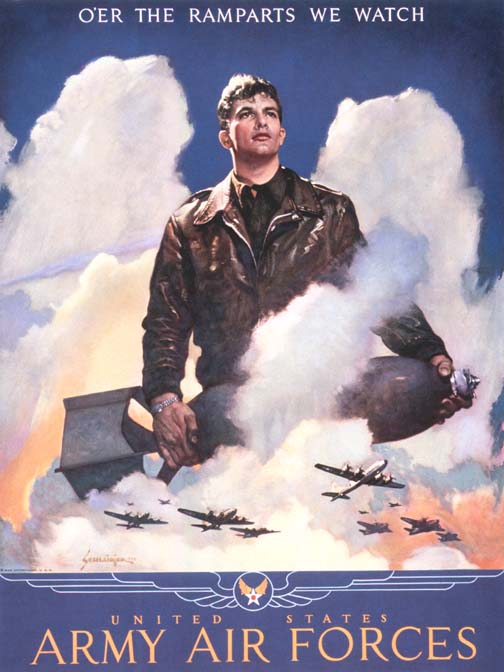
Army Air Forces
Building an Air War Across the World
They flew us in low over the field, and I remember thinking how many airplanes were already there. Rows of them. More than I’d ever seen in one place. Men were unloading gear, engines were running, and nobody looked lost. Whatever this was, it had been growing for a while.
During World War II, the United States fought the air war through the Army Air Forces, the aerial arm of the U.S. Army. There was no separate Air Force yet. Aviation was integrated directly into the Army’s structure, doctrine, and command, and airmen were soldiers first and flyers second.
What emerged during the war was an organization of unprecedented size and reach. The Army Air Forces expanded rapidly, deploying aircraft and personnel across the globe to meet vastly different operational demands.
Air power was no longer confined to supporting ground troops. It became a decisive force in its own right—responsible for reconnaissance, air superiority, strategic bombing, transport, and maritime patrol.
A Global War in the Air
The Army Air Forces operated across multiple theaters, each with its own geography, climate, and enemy tactics:
-
European Theater
Strategic bombing campaigns, long-range escort missions, and air superiority operations over occupied Europe. -
Mediterranean Theater
Support of ground operations, attacks on supply lines, and operations across North Africa and Southern Europe. -
Atlantic Theater
Maritime patrol, convoy protection, and the fight against German U-boats threatening vital supply routes. -
Pacific Theater
Long-distance operations across vast ocean spaces, island-hopping campaigns, reconnaissance, and naval coordination.
Each theater required different aircraft, tactics, and levels of endurance. Distance, weather, navigation, and logistics shaped every mission.
Organization and Command
The scale of operations demanded new approaches to organization and leadership. Air forces were divided into numbered commands, each responsible for specific regions and mission types. Coordination between reconnaissance units, bomber groups, fighter escorts, and naval forces became essential.
Decisions made in briefing rooms thousands of miles from the front could determine whether missions succeeded—or failed—before aircraft ever left the ground.
Men, Machines, and Momentum
The rapid growth of the Army Air Forces brought together men from every part of the country. Training programs were expanded, airfields were built almost overnight, and aircraft production reached levels never before attempted.
Despite the scale, the war was still fought by individuals—pilots, navigators, gunners, mechanics, and support crews—whose daily routines carried global consequences.
The Army Air Forces did not begin the war as a fully formed institution. It became one through necessity, experience, and sacrifice, evolving in real time as the conflict unfolded.
Continue Through WWII
-
Aircrews & Squadrons
-
Surviving the War
-
Air War
-
Reconnaissance
-
Winning WWII
-
Wartime Culture