

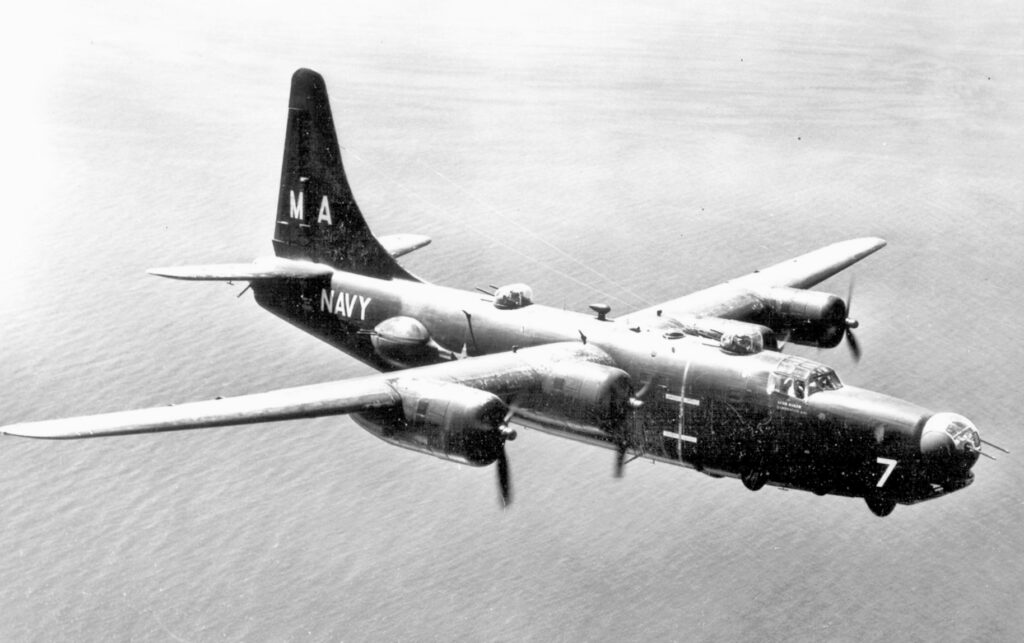
PB4Y-2 Privateer
A Purpose-Built Naval Patrol Aircraft
The PB4Y-2 Privateer was the final and most specialized evolution of the Liberator lineage. While derived from the B-24, the Privateer was no longer simply a bomber adapted for naval use. It was a purpose-built maritime patrol aircraft, designed specifically to meet the U.S. Navy’s requirements for long-range ocean surveillance, anti-submarine warfare, and persistent patrol operations.
In the PB4Y-2, the Liberator ceased to be a bomber and became a naval guardian of the sea lanes.
From Adaptation to Specialization
Experience with the PB4Y-1 demonstrated the value of long-range patrol aircraft—but also revealed the limitations of using a bomber airframe without deeper modification. The Privateer addressed these issues through substantial redesign.
Key changes included:
-
a single vertical tail, replacing the B-24’s twin fins for improved stability
-
structural reinforcement for long, low-altitude patrol missions
-
revised crew layout optimized for maritime operations
-
equipment dedicated to detection, tracking, and endurance
These changes transformed the aircraft’s handling characteristics and made it better suited for the demanding conditions of naval patrol.
Fleet’s insistence on personally flying and evaluating stability issues during testing informed key design decisions, including changes that led toward improved directional stability in later naval variants.
Designed for Endurance, Not Bombing Runs
Unlike strategic bombers that operated in tight formations and short target windows, the PB4Y-2 was designed to remain airborne for long periods while searching vast areas of ocean.
Its mission profile emphasized:
-
sustained patrols
-
slow, methodical search patterns
-
coordination with surface vessels
-
rapid response to submarine contacts
In this role, reliability and endurance were more important than speed or altitude.
Search & Patrol
The Privateer’s primary role was wide-area maritime patrol. Crews flew long missions over open ocean, scanning shipping lanes, choke points, and suspected submarine operating areas.
These patrols:
-
deterred enemy movement
-
provided early warning of threats
-
maintained constant pressure on submarines
The mere presence of a Privateer overhead could force submarines to remain submerged, reducing their operational effectiveness.
Anti-Submarine Warfare (ASW)
In the ASW role, the PB4Y-2 worked as part of an integrated naval system. Once a submarine was detected, the Privateer could:
-
track its position
-
attack with depth charges
-
coordinate with destroyers and escort vessels
The aircraft’s endurance allowed it to remain on station, maintaining contact until surface forces arrived—a critical capability in open-ocean warfare.
Radar-Equipped Variants
Advances in radar technology significantly enhanced the Privateer’s effectiveness. Radar-equipped versions could:
-
detect surfaced submarines beyond visual range
-
operate in poor weather or darkness
-
conduct night patrols with greater confidence
These capabilities extended naval air power into conditions that once favored submarine operations.
Service and Legacy
The PB4Y-2 Privateer entered service late in World War II but remained in use well into the postwar era. Its design proved so effective that it continued to serve as a frontline maritime patrol aircraft long after the conflict ended.
The Privateer’s legacy lies in its demonstration that control of the seas depended on persistent aerial presence, not just naval firepower.
The Final Liberator
As the last major evolution of the Liberator family, the PB4Y-2 Privateer represents the culmination of years of wartime experience and adaptation. It closed the chapter on the B-24 lineage while opening a new era in maritime patrol aviation.
From bomber to patrol aircraft, the Liberator’s final form stood watch over the oceans—long after the guns fell silent.
Continue Exploring Naval & Bomber History
-
Other Consolidated Bombers
-
Bomber Strategies
-
WWII Aircrew Survival & Training
-
The Enemy: Threats in the Air and at Sea