

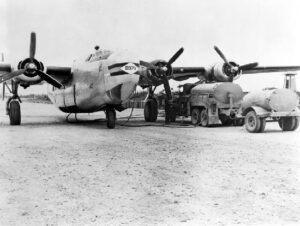
C-109 Tanker
Fueling the War From the Sky
The C-109 Tanker was a specialized transport variant of the B-24 Liberator, engineered to solve one of World War II’s most urgent logistical problems: getting aviation fuel over vast distances and into some of the most remote, dangerous regions on Earth. Built by modifying the C-87/C-87A transport models, the C-109 carried nothing but fuel—turning the proven Liberator airframe into a flying lifeline for the Allied war effort.
Purpose-Built for Fuel Transport
As Allied operations expanded across Asia, the Pacific, and Europe, aviation fuel became one of the most strategically vital commodities of the war. Some critical routes, such as the supply line over the Himalayas known as “The Hump,” had no pipelines, ports, or safe overland pathways. Only aircraft could deliver the needed fuel, and those aircraft needed to fly higher, farther, and with heavier loads.
To meet this need, Consolidated’s engineers removed the C-87’s cargo fittings and installed multiple sealed tanks inside the fuselage—transforming the aircraft into an airborne fuel hauler.
Design Features
The C-109 incorporated several key changes:
-
installation of internal fuel tanks replacing cargo space
-
structural reinforcements for heavy liquid loads
-
modified venting and safety systems
-
optimized weight distribution to counter shifting fuel mass
-
simplified interiors designed purely for utility, not comfort
Although based on the same airframe as the C-87, the C-109’s mission was entirely different: it existed solely to move fuel where ground transport was impossible.
Flying “The Hump”
The C-109 is most remembered for its service flying the treacherous Himalayan air route connecting India and China. This mission involved:
-
extreme mountain winds
-
unpredictable weather
-
thin air affecting lift and engine performance
-
narrow margins for error due to payload weight
-
long distances over hostile or inaccessible terrain
Pilots described the C-109 as challenging but capable—requiring precision flying and deep respect for the aircraft’s handling when carrying full fuel loads.
Operational Challenges
Transporting liquid cargo introduced unique complications:
-
shifting fuel loads affected balance
-
fuel expansion in high-altitude conditions required careful monitoring
-
emergency landings were extremely dangerous with a full fuel load
Despite these difficulties, C-109 crews delivered enormous quantities of fuel that kept operations in Asia going during a critical phase of the war.
Strategic Importance
The C-109’s ability to deliver fuel directly to forward bases gave Allied commanders flexibility and operational reach far beyond what ground logistics could provide. Its contributions helped:
-
sustain fighter and bomber operations in China and Southeast Asia
-
enable long-range reconnaissance missions
-
support transport hubs and airfields across remote territories
-
maintain supply chains during monsoon seasons and disrupted ground routes
The C-109 was not glamorous, but it was indispensable.
Legacy
Today, the C-109 is remembered as a specialized workhorse—an aircraft designed for a single purpose and executed with wartime urgency. Though often overshadowed by the combat achievements of the B-24, its role in sustaining Allied operations across some of the most challenging regions on earth remains one of the most remarkable logistics achievements of WWII.
The C-109 demonstrated the versatility of the Liberator platform and stands as a testament to the engineers and aircrews who turned a bomber into a tanker and a desperate situation into a strategic advantage.