

R. H. Fleet Values & Leadership
The Principles That Shaped a Pioneer—and an Industry
Reuben H. Fleet was more than an entrepreneur or an aviation pioneer. He was a commander, a builder, a reformer, and above all, a man whose values shaped every airplane that left his factories. His leadership style was unmistakable: disciplined yet visionary, demanding yet fiercely loyal, uncompromising yet humane.
To the thousands who worked for him, he was simply “The Major.”
A title earned not only from his Army rank, but from the weight of responsibility he carried and the standards he imposed.
Fleet’s values were not slogans. They were operational principles—the bedrock on which he built the safest, most reliable aircraft of the early 20th century. They guided him through war, business, innovation, and national service.
This page explores the values that defined him and the stories that reveal the character behind the accomplishments.
Integrity
Fleet believed that aircraft were moral objects—life-or-death machines that demanded absolute honesty from anyone who built or flew them.
Workers recalled moments when he would halt production over a single flawed part. If a wing spar arrived a fraction outside tolerances, he ordered the entire batch rejected.
His reasoning was simple:
If one pilot dies because we cut a corner, that fault is ours.
Integrity wasn’t a virtue to him. It was a responsibility.
Responsibility
During World War I, Fleet oversaw America’s entire pilot-training system—a position of enormous pressure. Hundreds of young aviators depended on the reliability of the planes they trained in. Too many died because aircraft standards were inconsistent or dangerously outdated.
This experience shaped his lifelong sense of duty.
Later, when a government official confronted him with accusations of excessive profit, demanding he “give away airplanes,” Fleet held his ground. He offered the government the aircraft for one dollar each, preserving public trust without compromising his company or betraying his workers.
He knew responsibility meant making hard decisions—and standing by them.
Excellence
Fleet insisted on precision, discipline, and craftsmanship. Nothing less would do.
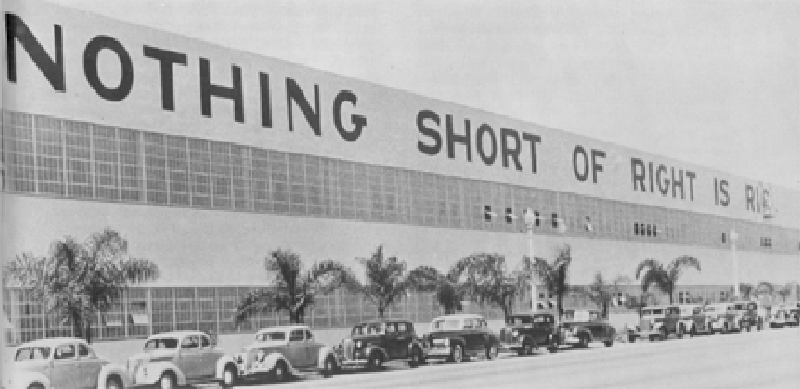
Above the entrance to the Consolidated factory, he had a sign hung that read:
NOTHING SHORT OF RIGHT IS RIGHT
On the first night only the word “NOTHING” was lit. Panic spread among workers—was the company shutting down? Had war contracts evaporated?
By morning the full sign appeared. The message was unmistakable:
Excellence wasn’t optional. It was the culture.
Fleet’s standard for himself was the same as his standard for his aircraft:
Make it right or don’t make it at all.
Innovation
Fleet did not chase novelty for its own sake. He innovated to solve real problems—often ones that killed pilots.
When aircraft of the WWI era frequently entered unrecoverable spins, Fleet designed a fuel-balancing system that used centrifugal force to stabilize the aircraft. It dramatically reduced training fatalities.
He pushed for metal aircraft construction, long-range flying boats, advanced training systems, and revolutionary bomber designs—not because they were fashionable, but because aviation needed them.
Innovation, for Fleet, was a moral imperative.
Leadership by Experience: Fleet Takes the Controls
During the development and testing of one of Consolidated’s large bomber designs, engineers encountered a persistent stability problem. Reports from test pilots and technical data pointed to an issue that resisted clear explanation.
Conventional wisdom suggested further test flights by experienced pilots.
Reuben H. Fleet refused.
Fleet was not content to rely solely on secondhand reports. Despite the risks involved—and despite the objections of those who reminded him that his life, and the future of the company, were at stake—he insisted on flying the aircraft himself.
It was an extraordinary decision. Fleet was not a young test pilot, nor was he required to take such risks. But he believed that understanding an aircraft meant experiencing it directly.
Fleet took the controls.
After flying the aircraft and feeling the instability firsthand, he returned with clarity that no report could provide. The problem was not theoretical. It was evident in the aircraft’s response, its balance, and the way it behaved in the air.
Based on his observations, Fleet directed design changes that addressed the issue and influenced subsequent development decisions.
This moment became emblematic of Fleet’s leadership style. He did not lead from behind a desk. When the stakes were high and the answers uncertain, he was willing to risk himself to understand the problem fully—and to ensure the aircraft was made right.
Leadership
Fleet’s leadership style blended military clarity with entrepreneurial daring. He had no patience for mediocrity, but he cared deeply for the people who served under him.
He walked factory floors.
He spoke to welders, riveters, and engineers alike.
He expected precision—but he respected every contributor to the mission.
When he sold real estate in his early career, he used the line:
“The greatest investment on Earth is the Earth itself.”
It reflected both his practicality and his confidence—a confidence that later carried him through the founding of Consolidated Aircraft and the building of America’s first great aviation empire.
His leadership changed industrial culture, and pilots trusted his aircraft with their lives.
The Major’s Legacy of Character
Fleet’s values created more than a company. They established a culture of safety, discipline, and innovation that shaped the entire trajectory of American aviation.
Every aircraft he approved carried his signature principles:
integrity, responsibility, excellence, innovation, and leadership.
These values outlived him.
They still echo through the Fleet Science Center, through the stories of veterans, through aviation history—and now, through this archive.
Not because he spoke about them—
but because he lived them.